To view commodity insights, please follow this link: Commodity Insights
Weekly Energy Industry Summary
Week of October 19, 2026
Policy Landscape – U.S. Federal and State
New Jersey Holds RGGI Hearing Focused on Ratepayer Relief
- Hearing held: On October 15, New Jersey’s BPU and DEP held a joint hearing focused on RGGI allowance prices and ratepayer relief.
- Why the hearing was required: Under New Jersey law, if RGGI auction clearing prices exceed $7 per allowance in two consecutive auctions, BPU and DEP must develop an action plan for immediate ratepayer relief, hold a public hearing, and issue findings and recommendations.
- Allowance prices remain elevated: The state’s action plan states that the clearing price has exceeded the statutory threshold at every auction since December 2, 2020.
- Focus on affordability: BPU and DEP are evaluating how RGGI allowance prices affect ratepayers and potential approaches for short- and long-term consumer bill stabilization and reduction.
- RGGI remains in place: New Jersey continues to participate in RGGI, which requires covered fossil-fuel power plants of 25 MW or greater to obtain allowances corresponding to their CO₂ emissions
- Stakeholder concerns raised: Based on the hearing summary you provided, some commenters raised concerns about electricity prices and emissions leakage, while others supported continued participation and suggested approaches such as a border adjustment.
- Next step: Written comments on the ratepayer-relief action plan are due November 13, 2026, after which the hearing will inform the agencies’ subsequent report.
Bottom line: New Jersey’s current focus is on addressing affordability and ratepayer impacts associated with elevated RGGI allowance prices, rather than ending its participation in RGGI.
LevelTen Energy Snapshot Graphs and Commentary
LevelTen Energy’s snapshot on U.S. and EU Power Purchasing Agreement (PPA) pricing is below. For more information on LevelTen please visit www.leveltenenergy.com.
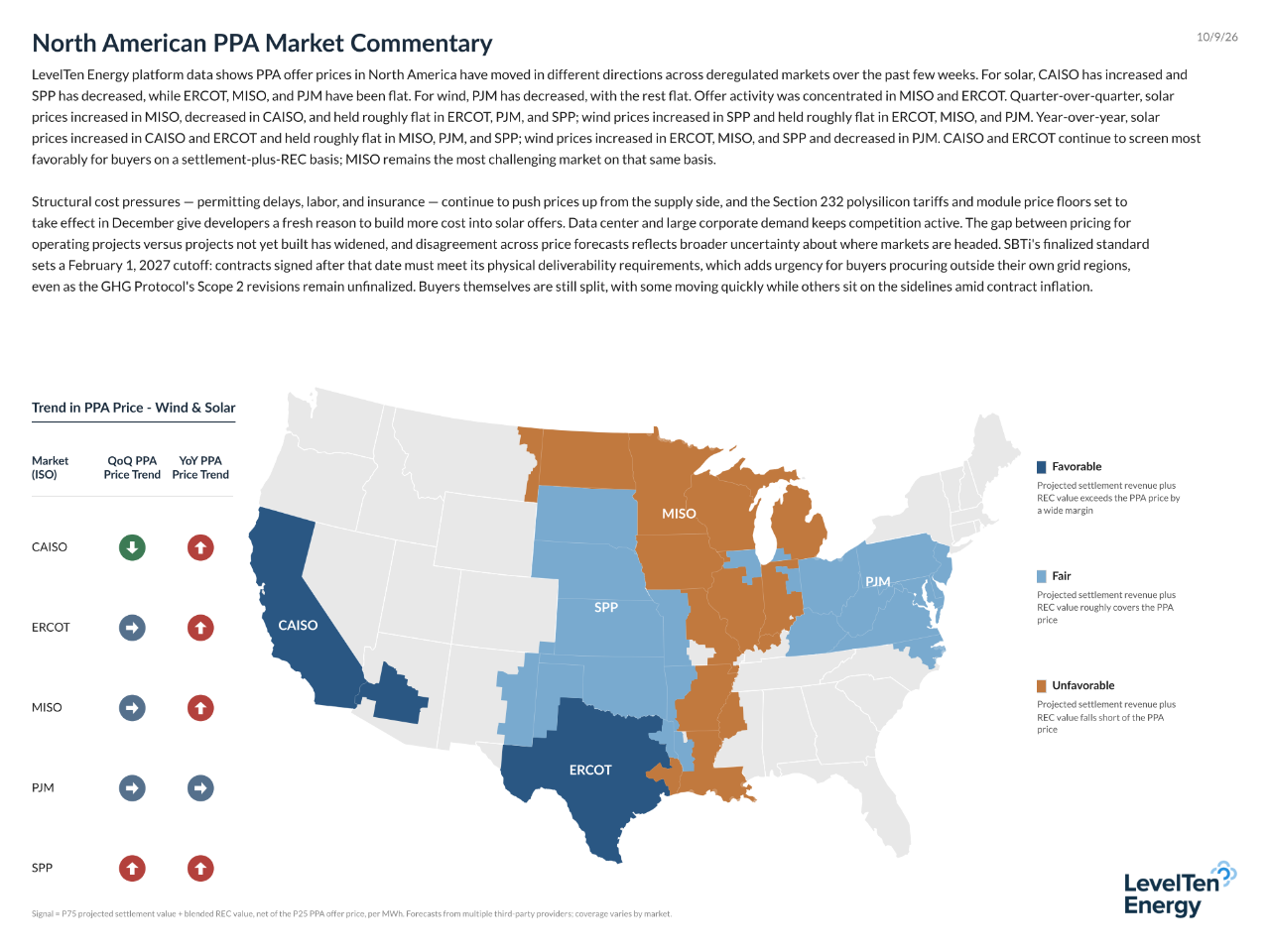
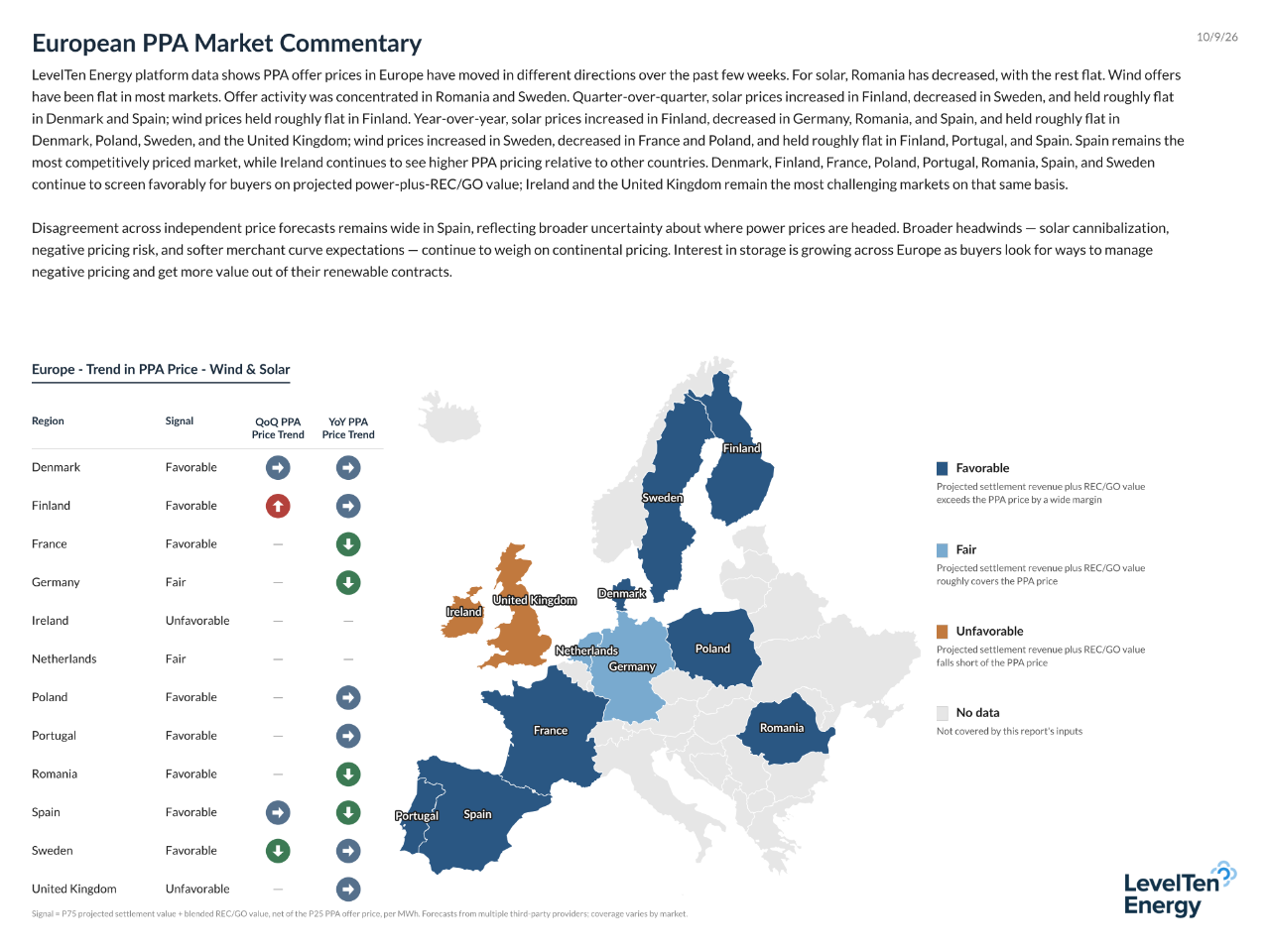
In the News
EPA Finalizes Repeal of 2024 Power Plant Regulations, Delivering $300+ Billion in Savings, Proposes Repeal of All Remaining Greenhouse Gas Emissions Standards for Power Plants
The EPA announced the repeal of most of the 2024 power plant greenhouse gas standards and proposed rescinding the remaining federal GHG requirements for the power sector, describing the move as a significant shift aimed at supporting reliable, affordable baseload power generation. The agency states the actions could reduce compliance costs and provide greater regulatory certainty for coal and natural gas generation, while opening a public comment and review process before any remaining changes are finalized.
Read the full announcement for additional details and ongoing regulatory developments.
CARB Issues 520,000 New Offset Credits, Though None with Direct Environmental Benefits, Continuing Muted Issuance Year of 2026
The California Air Resources Board (CARB) issued approximately 520,000 new offset credits to mine methane capture projects, continuing a limited pace of offset issuance in 2026 and marking a second consecutive issuance period focused on a single project type. The issuance did not include projects with direct environmental benefit classifications, highlighting the continued scarcity of new offset supply entering California's carbon market this year
Sustainability Corner- Information on Sustainability Concepts & Regulatory Updates
Net Zero vs. Carbon Neutral
What is Carbon Neutral?
Carbon neutrality refers to a state where carbon dioxide (CO₂) emissions associated with an organization, product, service, event, or activity are balanced through a combination of emissions reductions and carbon offsets. Carbon neutrality does not necessarily require eliminating all emissions before using offsets.
Key Facts
- Focuses primarily on carbon dioxide (CO₂) emissions.
- Emissions may be balanced through carbon offset projects.
- Can apply to specific products, facilities, events, or entire organizations.
- There is no single universally accepted carbon-neutral standard.
What is Net Zero?
Net Zero refers to reducing greenhouse gas (GHG) emissions as close to zero as possible and balancing any remaining emissions through carbon removals. Net Zero generally applies across a company's entire emissions inventory and requires significant emissions reductions before addressing residual emissions.
Key Facts
- Covers all greenhouse gases, not just CO₂.
- Includes Scope 1, Scope 2, and often Scope 3 emissions.
- Requires substantial emissions reductions before neutralizing residual emissions.
- Carbon removals are used only for emissions that cannot be eliminated.
- Widely incorporated into corporate climate strategies and international climate targets.
Key Differences
- Carbon Neutral focuses primarily on balancing CO₂ emissions.
- Net Zero focuses on reducing all GHG emissions to the greatest extent possible before addressing remaining emissions.
- Carbon offsets are commonly used to achieve carbon neutrality.
- Net Zero typically relies on carbon removals for remaining residual emissions after reductions
Related Terms
- Carbon Offset: A reduction, avoidance, or removal of emissions used to compensate for emissions produced elsewhere.
- Carbon Removal: The process of removing CO₂ from the atmosphere through natural or technological methods.
- Residual Emissions: Emissions that remain after all feasible reduction measures have been implemented.
Key Takeaway:
Carbon Neutral focuses on balancing carbon dioxide (CO₂) emissions, often through a combination of emissions reductions and carbon offsets. Net Zero focuses on reducing all greenhouse gas (GHG) emissions as close to zero as possible before addressing remaining residual emissions through carbon removals.
For questions on these items and more please reach out to SustainabilityTeam@Constellation.com and your inquiry will be directed to an inhouse expert.
Stay up-to-date on the latest energy news and information:
Coming soon from Constellation Customer Insights: Help us provide you with greater service by completing our online study later this month. For a limited time, eligible customers can choose to accept an incentive for taking the time to provide feedback.
- Energy Market Intel Webinar - Register for our next market update webinar on Wednesday, October 21 at 2 p.m. ET when the CMG team will provide insights on market factors currently affecting energy prices, such as weather, gas storage and production, and domestic and global economic conditions.
- Fortunato & Friends Webcast - Stay tuned for information regarding our next Fortunato & Friends webinar featuring Constellation's Chief Economist and a special guest
- Energy Terms to Know - Learn important power, gas and weather terms.
- Sustainability Assessment - We invite you to complete a brief assessment that helps us learn where your company is in building and/or implementing a sustainability plan. Through these insights, Constellation can customize solutions to meet your needs.
- Subscription Center - Sign up to receive updates on the latest market trends.
Questions? Please reach out to our Commodities Management Group at CMG@constellation.com.