RESIDENTIAL COMMERCIAL SMALL BUSINESS
About Us Contact Us Log In
Constellation
  • Home Energy Options
    • Electricity By State
      • Texas
      • Connecticut
      • Maryland
      • Massachusetts
      • Pennsylvania
      • Other States
    • Natural Gas By State
      • Georgia
      • Illinois
      • Maryland
      • Ohio
      • Pennsylvania
      • Other States
    • Our Energy Products
      • Electricity
      • Natural Gas
      • Renewable Energy
      • EV Plans
      • Electricity + A/C Protection Plans
      • Solar
      • Nuclear Energy Plan
    • Household Energy Articles
      • How to Switch Utilities When Moving
      • What is a Free Nights Plan?
      • Average Household Utilities Cost
      • Energy-Saving Tips
      • More Household Energy Information
  • More For Your Home
    • Smart Home
      • Connect
    • Sustainable Solutions
      • Electric Vehicles
      • Renewable Energy
      • Solar
    • Home Services
      • Georgia
      • Maryland
      • Pennsylvania
      • Texas
    • Schedule Service
  • Energy 101
    • Energy Innovation
      • Best Thermostat Temp Settings
      • What is Energy Conservation?
      • What is Water Conservation?
      • What is a Smart Home
      • View All Articles
    • Energy Choice
      • How to Shop for Energy
      • Choosing an Energy Supplier
      • When are Electricity Rates Lowest?
      • How Does Electricity Pricing Work?
      • View All Articles
    • Weather Preparedness
      • Hurricane Safety Tips
      • Home Flooding Preparedness
      • Winter Storm Preparedness
      • Report a Power Outage
      • View All Articles
    • Energy Education
      • Home Tax Credits & Rebates
      • How to Read Your Energy Bill
      • Variable vs. Fixed-Rate Energy Plans
      • Short vs. Long-Term Energy Contracts
      • View All Articles
  • EV Solutions
      • EV Charger Installation
      • Rebates & Incentives
      • EV Electricity Plans
      • Cost of Ownership
  • My Account
      • Pay My Bill
      • Make Guest Payments
      • Payment Options
      • Renew Service
      • Find My Renewal
      • Constellation Rewards
      • Report A Power Outage
      • Refer A Friend
      • Benefits & Energy Tools
      • Blog
      • FAQs
      • Track My Enrollment
    • Customer Login

      New User? Register Now

VIEW PLANS
Constellation
  • Electricity & Natural Gas
    • Electricity
      • Purchasing Strategies
      • Sustainability Strategies
    • Natural Gas
      • Purchasing Strategies
      • Sustainability Strategies
    • Request a Quote Account Log In
  • Energy Resources
    • Resources
      • Natural Gas Tools
      • Subscription Center
      • Blogs
      • Podcasts
      • Energy Terms
    • Request a Quote Account Log In
  • Sustainability
    • Energy Efficiency
      • Energy Solutions
      • Efficiency Made Easy
    • Managing Carbon
      • Carbon-Free Energy Supply
      • Renewable Energy Certificates
      • Hourly CFE Matching
      • Carbon Offsets
      • Nuclear Solutions Suite
    • Renewable Energy
      • Constellation Offsite Renewables
      • Solar
      • Renewable Natural Gas
  • Channel Partners
      • Associations
  • Emerging Tech
      • Constellation Navigator
      • Tech Ventures
      • Energy Optimization
      • Flexible EV
      • Data Centers
Constellation
  • Small Business Solutions
      • Why Choose Constellation?
      • Electricity
      • Natural Gas
      • Commercial Services
      • Sustainability Solutions
      • Constellation Rewards
  • Energy Education Resources
      • Energy Shopping Tips
      • Calculate Your Supply Cost
      • Energy Choice for Small Business
      • Small Business Resource Center
      • Understanding Energy Suppliers
      • Small Business Expenses
VIEW PLANS
Menu
RESIDENTIAL
Home Energy Options
Electricity By State
Texas
Connecticut
Maryland
Massachusetts
Pennsylvania
Other States
Natural Gas By State
Georgia
Illinois
Maryland
Ohio
Pennsylvania
Other States
Our Energy Products
Electricity
Natural Gas
Renewable Energy
EV Plans
Electricity + A/C Protection Plans
Solar
Nuclear Energy Plan
Household Energy Articles
How to Switch Utilities When Moving
What is a Free Nights Plan?
Average Household Utilities Cost
Energy-Saving Tips
More Household Energy Information
More For Your Home
Smart Home
Connect
Sustainable Solutions
Electric Vehicles
Renewable Energy
Solar
Home Services
Georgia
Maryland
Pennsylvania
Texas
Energy 101
Energy Innovation
Best Thermostat Temp Settings
What is Energy Conservation?
What is Water Conservation?
What is a Smart Home
View All Articles
Energy Choice
How to Shop for Energy
Choosing an Energy Supplier
When are Electricity Rates Lowest?
How Does Electricity Pricing Work?
View All Articles
Weather Preparedness
Hurricane Safety Tips
Home Flooding Preparedness
Winter Storm Preparedness
Report a Power Outage
View All Articles
Energy Education
Home Tax Credits & Rebates
How to Read Your Energy Bill
Variable vs. Fixed-Rate Energy Plans
Short vs. Long-Term Energy Contracts
View All Articles
EV Solutions
EV Charger Installation
Rebates & Incentives
EV Electricity Plans
Cost of Ownership
My Account
Pay My Bill
Make Guest Payments
Payment Options
Renew Service
Find My Renewal
Constellation Rewards
Report A Power Outage
Refer A Friend
Benefits & Energy Tools
Blog
FAQs
Track My Enrollment
VIEW PLANS
COMMERCIAL
Electricity & Natural Gas
Electricity
Purchasing Strategies
Sustainability Strategies
Natural Gas
Purchasing Strategies
Sustainability Strategies
Energy Resources
Resources
Natural Gas Tools
Subscription Center
Blogs
Podcasts
Energy Terms
Sustainability
Energy Efficiency
Energy Solutions
Efficiency Made Easy
Managing Carbon
Carbon-Free Energy Supply
Renewable Energy Certificates
Hourly CFE Matching
Carbon Offsets
Nuclear Solutions Suite
Renewable Energy
Constellation Offsite Renewables
Solar
Renewable Natural Gas
Channel Partners
Associations
Emerging Tech
Constellation Navigator
Tech Ventures
Energy Optimization
Flexible EV
Data Centers
SMALL BUSINESS
Small Business Solutions
Why Choose Constellation?
Electricity
Natural Gas
Commercial Services
Sustainability Solutions
Constellation Rewards
Energy Education Resources
Energy Shopping Tips
Calculate Your Supply Cost
Energy Choice for Small Business
Small Business Resource Center
Understanding Energy Suppliers
Small Business Expenses
VIEW PLANS
About Us Contact Us Log In

How Many kWh Does a House Use?

  • Home Page
  • Energy 101: Resources to Help Understand Energy
  • Energy Education
  • How Many kWh Does a House Use?
Print

When asking how much electricity a house uses, you are taking an important step in gathering information you need to manage your energy bill.

While you can tell how much energy you are being charged for by looking at your monthly energy bill, it helps to know the national average. Maybe you are super efficient and beat the average kWh usage per month or maybe you are using more than most.

By understanding your home power usage and how it compares to the amount of , you can explore ways  cut your power  and run a more efficient home.

Table of contents:

  • What is the average home power consumption?
  • Average house kWh consumption per square feet
  • Average household power usage by state
  • What factors affect your home's energy usage?
  • What are the top appliances contributing to your house power usage?
  • What can you do to limit your home energy consumption?

What is the average home power consumption?

Average power consumption of a house.

Residential customers in the United States used an average of 10,791 kilowatt-hours of electricity in 2022. This works out to roughly 899 kilowatt-hours per month, or about 30 kilowatt-hours per day.

Frequency Home Electricity
Consumption (kWh)
Daily30
Monthly899
Yearly10,791


Average kWh usage per square foot

The size of your home is the largest factor when it comes to how much energy you use to heat and cool it. According to the EIA, the average U.S. home size is about 1,818 square feet and uses around 899 kWh per month. This equates to 0.49 kWh per square foot per month.

Home Size   Monthly Electricity
Consumption (kWh)
1,000490
1,500735
2,000980
2,5001,225
3,0001,470


As you compare your power consumption to typical house kWh usage averages, think about why your electricity use may be higher or lower. Maybe you have more people living in your house. Or you may use many power-hungry appliances or electronics. If you live in a place with long, hot summers or colder- than- average winters, your heating or air conditioning bills may be higher than the typical home energy consumption.

Which U.S. states use the most electricity per residential home?

Electricity consumption varies from state to state. Louisiana, with its hot, humid summers, has the highest annual electricity use, at 14,774 kWh per residential customer as of 2022. Southern and western desert states together use the most electricity per home.

State Total Electricity
Consumption (kWh)
Louisiana14,779
Tennessee14,220
Mississippi14,062
Florida13,990
Alabama13,810
Arizona13,603
Oklahoma13,579
South Carolina13,526
West Virginia13,462
Texas13,440

Data Source: EIA

Stay Connected with Constellation

Light up your inbox with energy-saving tips, Constellation news & special offers tailored for you

Thanks for signing up -- you'll hear from us soon!

Something went wrong. Please try again.

Average monthly energy usage by state

Find the typical house kWh usages by state below, with monthly electricity and bill averages,

State Monthly Electricity 
Usage (kWh)
Monthly Electricity 
Usage (ranking)
Average Monthly 
Bill (dollars)
Average Monthly 
Bill (ranking)
Average Electricity 
Rate (cents/kWh)
Average Electricity 
Rate (ranking)
Alabama11515170714.7330
Alaska621441551725.026
Arizona11346176415.5023
Arkansas1116111372812.2745
California54052185234.312
Colorado679411004814.7429
Connecticut65043174526.765
Delaware928201601417.2717
District of Columbia585481044617.7615
Florida116641591513.6337
Georgia1106131651014.9227
Hawaii66542293144.141
Idaho924231074511.5549
Illinois704361184216.7118
Indiana970181482015.2724
Iowa855301224014.2331
Kansas902251283414.1433
Kentucky1111121442312.9441
Louisiana123211422511.4950
Maine587471204120.4810
Maryland96119169817.6316
Massachusetts60346173628.703
Michigan698381363019.4411
Minnesota778321223915.6922
Mississippi117231621113.8635
Missouri999161263512.6243
Montana776331034713.2639
Nebraska893271094412.2246
Nevada925221501916.1820
New Hampshire606451392623.018
New Jersey692391293318.5812
New Mexico68640955013.8436
New York576491362923.607
North Carolina1042151482114.1832
North Dakota987171293213.0440
Ohio857291432416.6519
Oklahoma113271323111.7048
Oregon928211392715.0325
Pennsylvania854311551818.1013
Rhode Island576501621328.094
South Carolina112781591614.0734
South Dakota898261223813.6338
Tennessee118521482212.4644
Texas112010165914.7428
Utah76035845111.0151
Vermont562511253622.309
Virginia1078141621215.0226
Washington916241114312.1647
West Virginia11229179315.9821
Wisconsin703371253717.8214
Wyoming76534984912.8142

Data sources: EIA Average Retail Price of Electricity to Residential Sector, May 2024, EIA Annual household site fuel consumption in U.S. homes by state

What factors affect your home's energy usage?

The size of your home, location and climate, insulation and building materials, the number of residents, the number and type of appliances, how frequently you use those appliances, and your heating source all directly impact your home's energy consumption. Let's dive in to understand exactly how each of these factors influences your overall energy usage:
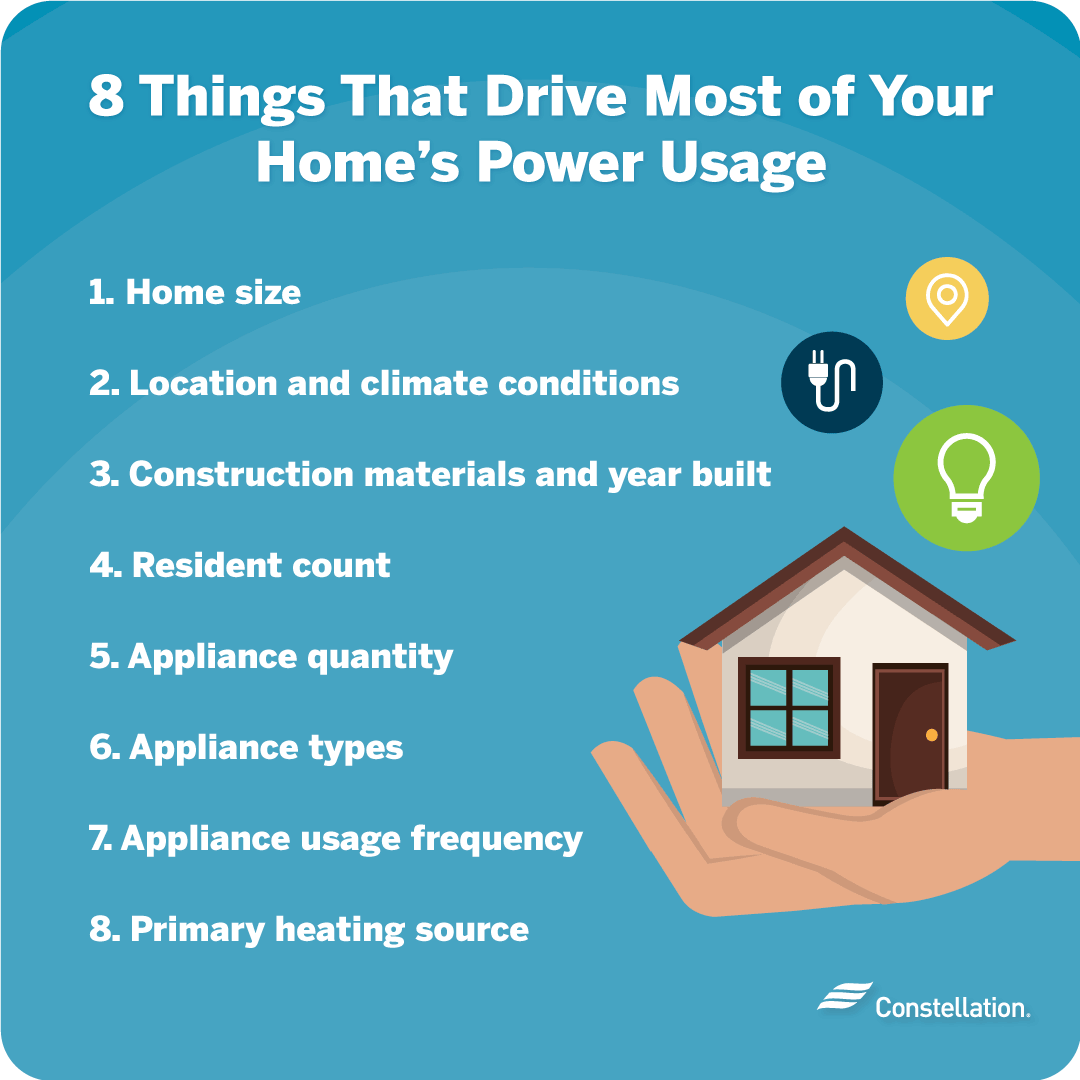
Factors that affect your home’s energy usage.
  • Size of your home. Larger homes typically consume more energy than smaller homes because it usually takes more energy to heat and cool a bigger space.
  • Geographic location and climate. If you live in an area with milder weather, you may be able to cool or heat your home more efficiently than a home in an area that experiences more extreme temperatures.
  • Your home’s building materials and year of construction. The materials used to build your home may not be energy efficient. If you own an older home, it may not be well insulated.
  • Number of residents. More people living in your home using devices and appliances will increase your average household electricity consumption.
  • Number of appliances. The more appliances used in your house, the higher your energy usage.
  • Type of appliances. Older appliances often weren’t designed to use minimal power, which is why it is often worth replacing them with newer energy-efficient appliances.
  • How often appliances are used. You will use less energy by operating appliances less often, such as waiting to run the dishwasher until it’s full. Another home energy savings tip is to unplug devices when not in use.
  • Main heating fuel. If your home has an electric heating system, you will use much more electricity than one that uses natural gas or heating oil.

What are the top appliances contributing to your house power usage?

Major contributors to your home's electricity use include your AC, water heaters, kitchen appliances (like refrigerators, ovens, and dishwashers), laundry machines, lighting, and entertainment electronics. Let’s explore how each of these impacts your overall energy consumption.

  1. Heating and cooling equipment. Air conditioners, all types of electric heaters and other HVAC equipment are often used around the clock in winter and summer, driving up the average kWh usage per month in most homes. Air conditioning alone accounts for nearly 19% of the average power consumption of a house.
  2. Water heaters. Heating water is the second biggest consumer of power in most homes.
  3. Refrigerators and freezers. Since refrigerators and freezers are always running, they’re always consuming energy, making up a large amount of the average kWh usage per day in your home. And with 34% of homes in the United States having two or more refrigerators, the energy they consume quickly adds up.
  4. Light fixtures. In 2020, residential homes in the United States used a total of 62 billion kWh of electricity on lighting. Lower your energy consumption by replacing incandescent lights with LED or CFL bulbs.
  5. Home entertainment systems. From televisions and gaming consoles to DVRs and streaming services, home entertainment can consume a good amount of energy. In 2020, these devices consumed 61 billion kWh of electricity in American homes.
  6. Washing machines and dryers. The more people living in your home, the more often you run your washer and dryer and the more power you use. You can reduce usage with these ways to save energy while doing laundry.
  7. Ovens and stovetops. Electric ovens and stove tops are also powerhungry appliances. Switching to an induction range is 5% to 10% more efficient than traditional electric models.
  8. Dishwashers. Dishwashers that run often will add to your energy usage. Upgrading to an energy-efficient dishwasher, running it only when full and not using the drying option will slash the energy you use.

When looking for ways to reduce your power usage, this tool from Energy.gov can help you estimate the energy your appliances use. Once you know where the power is going, you can take steps to lower your overall electricity consumption.

What can you do to limit your home energy consumption?

Investing in energy-efficient appliances, automating your home with smart devices, adding insulation, unplugging unused electronics, adjusting your daily energy habits, and scheduling a home energy audit are effective ways to significantly reduce your home’s energy usage. Let’s dive into the details to see how each can help:
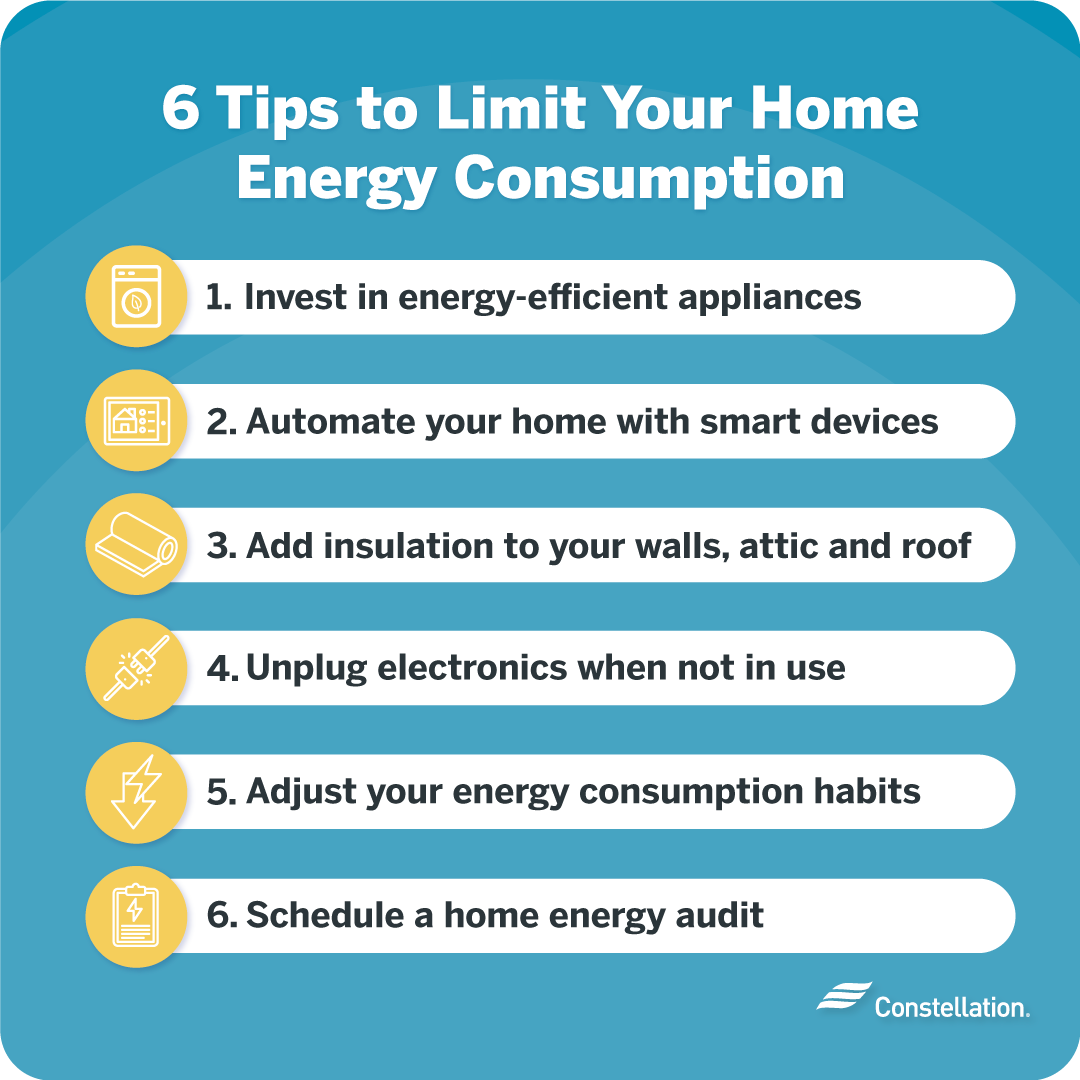
Tips to limit your home energy consumption

Now that you have a handle on how many kWh does a house use and how your own average kWh usage per month compares, you are ready to put ways to save energy in your home into action.

Here are some ideas for where to start:

Invest in energy-efficient appliances

Upgrading to energy-efficient appliances is a great way to reduce home energy usage. Look for appliances with the yellow ENERGY STAR® label, as they consume less power and may even qualify for rebates.

An energy-efficient refrigerator certified by ENERGY STAR® uses an average of 33% less energy than models that are more than 15 years old.

Automate your home with smart devices

Looking for another way to limit how much energy a house uses? Smart tech automates your home appliances and other aspects of your house to optimize energy usage. This technology also gives you the ability to monitor and adjust your energy usage remotely.

You can connect any device to your smart home system by plugging it into a smart plug. With so many smart plug uses, you can experiment to find what saves you the most energy.

Add insulation to your walls, attic and roof

Without proper insulation, your house can lose a significant amount of the hot or cold air produced by your HVAC system. Your heater and air conditioner will have to work harder and use more electricity to keep your home at a comfortable temperature. Insulating your walls will increase your home’s efficiency. Adding roof and attic insulation, and adding weatherstripping to doors and windows, also will cut down on your power usage.

Unplug electronics when not in use

Many devices and appliances use power in standby mode. Put an end to this waste by unplugging your electronics when not in use. While “sleep” or “standby” mode is convenient, you pay for it through a higher power bill. This is an especially important tip for saving energy if you are working from home.

Adjust your energy consumption habits

Simple things like turning the lights off when you leave a room, running fewer loads of laundry and ending energy-wasting habits all will reduce the average power consumption of a house. The energy consumption of streaming devices is substantial, along with gaming console energy consumption. Both add considerably to your overall home power usage.Turn them off to help save energy.

Schedule a home energy audit

Get a professional home energy audit as a first step in taking greater control over the amount of power you use. An auditor will tell you how you are using energy and will suggest ways to reduce your average home power consumption.

The audit process commonly finds air leaks and places where you don’t have enough insulation. If the audit finds air leaks in your home, you will know where to improve weatherstripping and insulation.

It is important to know how many kWh per day is normal for your home’s size and how much energy your specific home uses. Comparing the average kWh usage per day or per month for your home give you insight into if you are overpaying for energy.

When you understand your energy costs, you will likely find it easier to reduce your usage, be more efficient, and get more value from the power you use–with a lower energy bill, too.

Explore Energy Plans in Your Area

Zip Code is not valid

Residential
Home Energy Options
Home Services
Payment Options
Rates & Plans
Refer a Friend
FAQs
Residential Energy Information
Pay My Bill
Account Login
Home Energy Options
Home Services
Payment Options
Rates & Plans
Refer a Friend
FAQs
Residential Energy Information
Pay My Bill
Account Login
Business
Request a Quote
Small & Medium Business
Commercial
Account Login
Channel Partner Portal
Request a Quote
Small & Medium Business
Commercial
Account Login
Channel Partner Portal
Corporate Information
About Constellation
Careers
Investors
Media Inquiries
Become a Partner
About Constellation
Careers
Investors
Media Inquiries
Become a Partner
Get In Touch
Contact Us
Business: 844-6-ENERGY
GA Residential: 877-677-4355
TX Residential: 888-900-7052
Other Residential: 855-465-1244
Home Services: 844-823-HOME
Search
Contact Us
Business: 844-6-ENERGY
GA Residential: 877-677-4355
TX Residential: 888-900-7052
Other Residential: 855-465-1244
Home Services: 844-823-HOME
Search
Join the conversation:

 | Privacy Policy  | Terms and Conditions | Blog Policy | California Collection Notice | Ethics Help Line

Trustpilot
Promotion logo

© 2026 Constellation. The offerings described herein are those of either Constellation NewEnergy, Inc., Constellation NewEnergy-Gas Division, LLC, Constellation Connect, LLC or Constellation Home Products & Services, LLC (d/b/a Constellation Home in Maryland and d/b/a Constellation in Georgia, Pennsylvania and Texas), each affiliates of each other. The prices of Constellation are not regulated by any state Public Utility Commission. You do not have to buy Constellation electricity, natural gas or any other products to receive the same quality regulated service from your local utility. Brand names and product names are trademarks or service marks of their respective holders. All rights reserved. 

Electricity or Gas Supplier License/Order #s and Home Services #s: CA 1359, CTA0032; CT 06-07-11, 01-06; DE 00-162; DC GA06-2, EA01-5; GA GM-46; IL 16-0205, 17-0330; IA G-0010; ME 2000-989; MD IR-655, IR-311, IR-500; MA GS-030, CS-015; MI U-14867, U-13660; NE NG-0043; NH DM 17-024; NJ GSL-0101, ESL-0016; OH 09-153G, 00-003E; PA A-125095, A-110036; OR ES4, RI 2379(Z1), D-96-6(E); TX 10014, B07305101; VA G-26, G-51, E-11A; TX Licenses HVAC TACLA 00107498R, Electrical TECL 343159, Service Plan TSCP #684, Plumbing #43217; GA REG CN-211051